
Okoume Boards for Boat Interiors and Yacht Cabinetry
A yacht interior is a furniture factory with a tide: every panel must be light, stable and finished to a standard the owner can see. Dongstar Wood's okoume range uses natural Okoume veneer in a pale red to pinkish tone with a uniform grain, at a density the page describes as relatively low compared with many hardwood plywoods, and it is offered with E1 and E0 low-emission glues for interior and marine work.
Key takeaways
- Natural Okoume veneer in a pale red to pinkish tone with a uniform grain structure.
- The page describes a relatively low density compared with many hardwood plywoods — easier to handle, dimensionally stable.
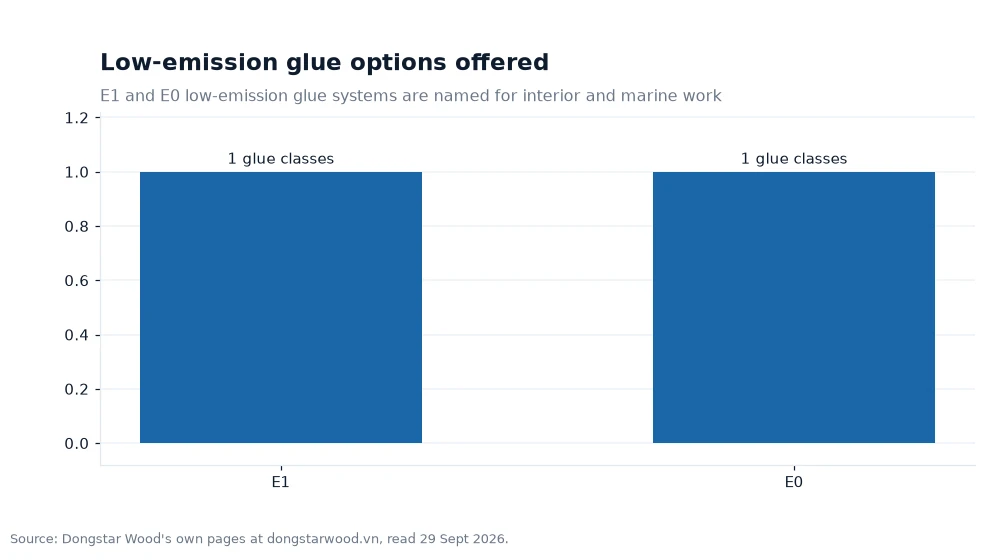
- Low-emission glue systems E1 and E0 are named for interior and marine work.
- CE EN13986 compliance is supported, per the page's own FAQ.
Why boat interiors choose okoume
Weight is the enemy inside a hull. Every kilogram of panel is a kilogram the boat carries, and the okoume page leans on exactly that: a relatively low density compared with many hardwood plywoods, which makes the panels easier to handle during fitting and keeps the interior dimensionally stable as the boat moves between climates. What the eye meets first is a calm, evenly grained veneer in warm pinkish red — a face that reads as furniture rather than as structure, which is what a saloon or a cabin is trying to be.
The face under finish
An interior panel is a finished surface, and the okoume page describes a smooth surface that accepts paints, stains, laminates and clear sealers. The route to that surface runs through calibrated veneers and precision pressing, which hold the thickness tolerance tight enough that a run of cabinet doors comes out the same width and the same thickness from first sheet to last. Tight tolerance matters twice in a boat: once at the cutting table, where a small drift ruins a fit, and again at the finish, where an even surface takes a clear coat without showing the sheet beneath.
The veneer calibration also affects how the panel handles adhesive. A smooth, even face spreads contact cement uniformly, while an uneven surface creates air pockets that weaken the bond. For boat interiors where laminates are applied to the face — a common finish in saloon furniture and cabinetry — the calibration of the okoume veneer is the hidden specification that determines whether the laminate sits flat or lifts at the edges. The precision pressing the page describes is not a luxury for boat work; it is a prerequisite for a finish that survives the motion of a vessel.
Glue classes for marine interiors
The page names low-emission glues E1 and E0 for interior and marine work, and the distinction is the bond line's behaviour in a damp, warm, occasionally salty environment. E1 is the standard low-emission class for occupied interiors; E0 steps the emission down further for enclosed spaces such as cabins and lockers where air changes slowly. The adhesive is also the panel's moisture defence: in a boat interior the glue line is what keeps a humid saloon from reaching the veneer edges, which is why the glue class belongs in the specification and not in the small print.
Compliance for construction and interior use
The page's FAQ states that many manufacturers support CE EN13986 compliance, and for a buyer that is the construction-product documentation that travels with the panel into the EU market. CE EN13986 is the harmonised standard for wood-based panels used in construction, and having it documented means the panel can be specified in a build file without a round of extra testing. Combined with the E1 and E0 glue options, the compliance story for an interior panel is complete: emissions documented, construction use documented, fibre source traceable.
The compliance documentation also matters for insurance and classification societies. A yacht builder who can show CE EN13986 documentation, E1 or E0 emission records and a traceable fibre source has a file that satisfies both the port authority and the underwriter. The documentation is not a formality: it is the proof that the panel used in the cabin was made to a standard, tested at a mill, and shipped with paperwork that matches the specification. For a custom build where every panel is different, having a mill that produces the documentation alongside the panel saves weeks of chasing paperwork after the fact.
Where okoume panels end up
The application list is a boat fit-out from stem to stern: yacht cabinetry and boat interiors, wall cladding, ceiling panels and partitions, doors, trims and decorative accents, and lightweight structural elements where a hardwood panel would be too heavy. The same sheet does furniture on land — chairs, tables, cabinets, wardrobes — because the face that works in a saloon works in a showroom. An Okoume Plywood Supplier who publishes the veneer, the density and the glue classes in one place lets a designer specify the interior from a single page.
| Characteristic | Published detail | Why it matters on a boat |
|---|---|---|
| Face veneer | Natural Okoume, pale red to pinkish | Uniform, furniture-grade appearance |
| Density | Relatively low vs many hardwood plywoods | Lighter panels, easier fitting |
| Surface | Calibrated, precision-pressed | Takes paint, stain, laminate, clear sealer |
| Glue classes | E1, E0 low-emission | Bond line and air quality in cabins |
| Compliance | CE EN13986 supported | Construction documentation for the EU |
Worked example: a cabin fit-out count
Example only, using the published characteristics. A cabin interior is specified by area, not by sheet count: the designer counts the panelled surface — walls, ceiling, locker faces — and matches it to the panel sizes the mill can supply. Because the page describes a relatively low density compared with many hardwood plywoods, the same panelled area in okoume weighs less than it would in a denser hardwood panel, and that saving is the specification rather than a footnote. The finish schedule stays simple when the whole cabin runs on one face and one glue class: one veneer to match, one adhesive to document, one surface to clear-coat.
Frequently asked questions
Why is okoume used in boat interiors?
The page describes a relatively low density compared with many hardwood plywoods, so the panels are easier to handle and keep their dimensional stability, and the natural Okoume veneer in a pale red to pinkish tone gives a uniform, furniture-grade face.
Which glues are offered for marine interiors?
The page names low-emission glue systems E1 and E0 for interior and marine work. The glue class belongs in the specification because the bond line is the panel's moisture defence in a damp saloon.
What compliance documentation is available?
The page's FAQ states that many manufacturers support CE EN13986 compliance, the harmonised construction-product standard for wood-based panels in the EU market, alongside the E1 and E0 low-emission glue options.
From veneer to varnished cabin
The panel a boat owner touches is the panel the designer specified, so fix the face and the glue class before the finish schedule. The birch range shows how the same factory documents a harder face for heavier work, and the company profile confirms the lines and the certifications behind every sheet. Designers who write the glue class into the specification at the drawing stage tend to get the interior air quality they asked for, rather than discovering it after the first season.
This article relies on numbers published by Dongstar Wood's own site consulted on 29 September 2026[1].