
A Reserve Target in Bitcoin: Planning 0.1 BTC From Pool Output
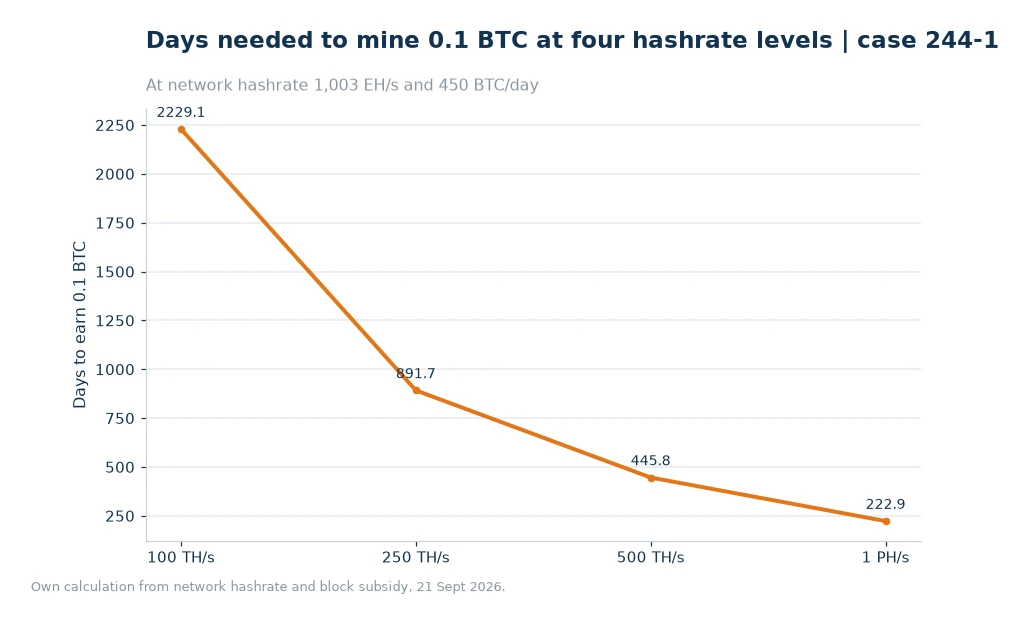
A reserve target is easier to manage when it has a date attached. At 100 TH/s, 0.1 BTC takes 2,229.1 days; at 1 PH/s it takes 222.9. The same coin amount can be a six-year background task or a three-quarter project, and the difference is capacity rather than intention.
Key takeaways
- 0.1 BTC takes 2,229.1 days at 100 TH/s, 891.7 at 250 TH/s, 445.8 at 500 TH/s and 222.9 at 1 PH/s.
- A quarterly review produces 0.004037 BTC at 100 TH/s, which is enough to show a trend and small enough to survive one bad month.
- Pool Hashrate turns capacity into a calendar; a rising network total moves the date without touching the hardware.
- Pool Luck belongs in a variance allowance, not in the expected column of a reserve plan.
Why a treasurer wants a date, not a rate
A rate is a number that looks stable until it is not. A date is a commitment that can be checked. Treasurers prefer dates because they can be compared with a review cycle, a loan maturity or a budget year, and because a missed date starts a conversation that a slightly lower rate never does.
Mining output can supply either, but only one of them honestly. The daily credit is variable in ways the operator cannot control, while the date for a fixed coin amount is an estimate that can be refreshed. Presenting the output as a rate invites a comparison with a deposit; presenting it as a date invites a comparison with a project plan, which is the more accurate frame.
The reserve target in days
At 100 TH/s the daily credit is 0.000044861 BTC, so 0.1 BTC takes 2,229.1 days, or 6.1 years. At 1 PH/s the daily credit is 0.00044861 BTC and the same target takes 222.9 days. The coin amount is identical; the organisational commitment is not. One is a background task that outlives several budget cycles, the other is a project with a start and an end.
Most small operations sit between those poles, which is why the middle of the ladder is worth studying. At 250 TH/s the target takes 891.7 days, about two and a half years. That is long enough to require a review habit and short enough that the hardware bought at the start can plausibly still be running at the end.
Pool Hashrate is an input you can measure
The ViaBTC Pool Hashrate page gives the divisor for every estimate on this page. It is also the one input a treasurer can observe without trusting a vendor, which makes it valuable in a review meeting. The number is public, current and independent of the hardware invoice.
Record it at each review rather than looking it up only when a number is questioned. A series of readings shows whether the estimate is drifting and by how much, which is more useful than a single snapshot. If the divisor has risen 8% since the plan was written, the date has moved by roughly 8% and the reserve target is unchanged.
Pool Luck and the variance allowance
Pool Luck is the difference between the blocks a pool found and the number expected from its share. It matters to the shape of the record, especially under PPLNS, where a quiet stretch is followed by a busy one. For a reserve plan, the right response is an allowance rather than a forecast: decide how much of a shortfall the reserve can absorb and how the plan responds if it does not.
A simple allowance is one quarter of output. At 100 TH/s that is about 0.004037 BTC, which covers a few weeks of poor luck or a short outage without touching the target date. At 1 PH/s the same quarter is 0.040375 BTC, larger in absolute terms and proportionally identical. The size scales; the principle does not.
The reserve grid
The table puts the target, the review unit and the horizon side by side. The quarterly column is the one to compare with a review calendar; the years column is the one to compare with a hardware replacement cycle.
| Hashrate | Days to 0.1 BTC | BTC per quarter | Horizon in years |
|---|---|---|---|
| 100 TH/s | 2229.1 | 0.004037 | 6.11 |
| 250 TH/s | 891.7 | 0.010094 | 2.44 |
| 500 TH/s | 445.8 | 0.020187 | 1.22 |
| 1 PH/s | 222.9 | 0.040375 | 0.61 |
Read the top row as a test of patience and the bottom row as a test of capital. The quarter column shows why the top row needs a review habit: three months of output is 4% of the target, small enough that a single reading tells you little. The bottom row produces 40% of the target in a quarter, so a review there is almost a post-mortem.
Set a review point, not a promise
A reserve plan should name the date of the next review and the three numbers to bring: delivered hashrate, network total and balance. Nothing else is required. If the balance is behind the quarterly column, the first two numbers usually explain why, and the response is a maintenance task or a revised date rather than a new strategy.
Avoid promising a coin amount to anyone outside the operation. Internally, a target is a useful coordinating device; externally, it becomes a commitment that the network total can invalidate without anyone in the room changing a decision. State the capacity and the assumptions, and let the date be the output of the arithmetic rather than a promise made in advance.
What happens if the target slips
It will probably slip at least once. A difficulty adjustment, a repair, a tariff change or a decision to add capacity can each move the date. The plan should say in advance which of those triggers a re-plan and which is absorbed by the allowance. A slip that is absorbed is normal; a slip that forces a sale at a bad moment is a design flaw.
Write the trigger as a number, not a feeling: a 10% rise in the network total, a 15% fall in delivered hashrate, or a quarter that lands more than 20% below the column. When one fires, redo the estimate and record the new date beside the old one. The history of those revisions is the most useful document the operation will produce.
Worked example
Reproduce the 100 TH/s row, then check the quarterly figure.
- Begin with 450 BTC spread over 1,003,100,000 TH/s: 0.00000044861 BTC per TH/s.
- At 100 TH/s the result is 100 × 0.00000044861 = 0.000044861 BTC a day.
- Days to 0.1 BTC: 0.1 ÷ 0.000044861 = 2229.1.
- Years: 2229.1 ÷ 365 = 6.11.
- Quarterly output: 0.000044861 × 90 = 0.004037 BTC.
- At 1 PH/s: 0.00044861 BTC a day, so 0.1 ÷ 0.00044861 = 222.9 days, and 90 days gives 0.040375 BTC.
Frequently asked questions
How long does 0.1 BTC take at 100 TH/s?
2,229.1 days, about 6.1 years, with a daily credit of 0.000044861 BTC while the network sits at 1,003 EH/s.
Why plan around a date instead of a monthly rate?
Because the date can be checked and revised against a review cycle, while a rate suggests a stability that mining output does not have. Difficulty, uptime and luck all feed the daily figure.
How much should the variance allowance be?
One quarter of expected output is a workable starting point: 0.004037 BTC per quarter at 100 TH/s, or 0.040375 BTC at 1 PH/s, which covers a short outage or a poor stretch without moving the target date.
Bring three numbers to the next review
Put the next review date in the calendar and list the three inputs on the invite: delivered hashrate, network total, balance. Anyone can prepare that in ten minutes. The comparison with the quarterly column then takes another ten, and the plan either continues or gets a new date with a reason attached.
The Collateral-Pledged Loans page matters if the reserve is also collateral, and the multi-currency wallet holds the balance and the payout history together. Both are inputs to the review, not substitutes for it.
Sources: ViaBTC pool state, loan and wallet pages; chain inputs read 21 Sept 2026: network hashrate 1,003 EH/s, difficulty 132.76 T, subsidy 3.125 BTC per block, 144 blocks a day, BTC $84,692. Quarters are 90 days and years 365. Figures read 21 Sept 2026, published 24 Oct 2026[1].